Fresh Air Without Guesswork: A Plain Look at Home Ventilation
Natural airing, exhaust fans, and balanced mechanical systems each move air differently. The right choice depends on the home, its occupants, and the signs that ordinary airing is not enough.
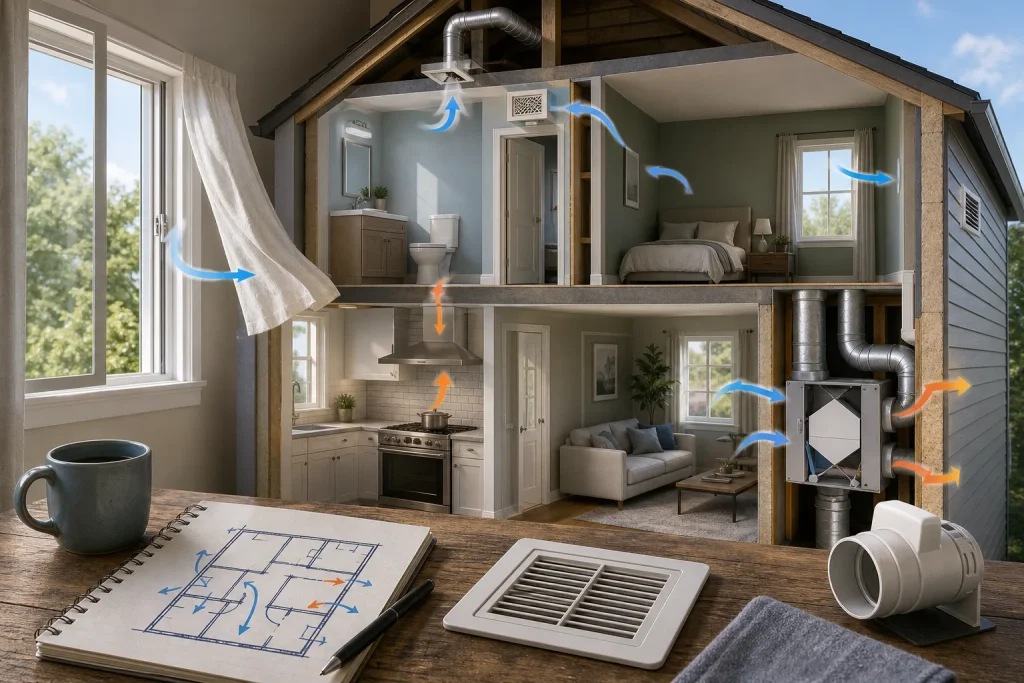
You open a bedroom window after waking and hear traffic, feel the curtain stir, then close it because the room is getting cold. The air has changed, more or less. Whether that simple routine is enough depends on the home, the weather, and what is happening indoors.
Ventilation replaces indoor air with outdoor air and gives moisture, odors, and other indoor pollutants a route out. It is distinct from heating and cooling: a furnace can warm stale air, and an air conditioner can cool it, without bringing in fresh air. Three common approaches—natural airing, local exhaust, and whole-home mechanical ventilation—solve different problems. Choosing among them starts with noticing how air moves through your home.
What does ordinary window airing do well?
Natural ventilation relies on wind, temperature differences, and openings such as windows, doors, and vents. Opening windows on opposite sides of a home can create a cross-breeze. A single open window can still exchange air, though the result depends on conditions outside and the path air can take indoors.
This approach suits homes where occupants can open windows regularly, outdoor air is reasonably clean and comfortable, and indoor moisture or odors are not persistent problems. It is easy to understand and needs no fan or ductwork. It also gives you direct control: open a window when cooking smells linger, or air a room when the weather allows.
That control has limits. Wind may make one airing session effective and the next one barely noticeable. A closed bedroom door can restrict the route between an open window and the rest of the home. Noise, outdoor smoke, pollen, security concerns, or uncomfortable temperatures may make open windows impractical. Natural ventilation is an option, not a reliable schedule that the weather has agreed to follow.
For a brief airing, open more than one window if the layout and outdoor conditions make that sensible, then close them when the room feels comfortable again. There is no need to leave a window tilted all day merely to prove a point. In cold weather, that can make nearby surfaces chilly without ensuring that the rest of the home gets useful air exchange.
When do local exhaust fans make sense?
Local exhaust removes air at the source. A bathroom fan pulls humid air outdoors, while a range hood can carry cooking moisture and odors away from the kitchen. These fans are often a practical choice where the main concern is specific: a bathroom that stays damp after showers, or a kitchen where cooking residue settles beyond the stove.
The details matter. A fan that simply recirculates air through a filter is not the same as one that exhausts outdoors. Ducts need an outdoor termination, and a blocked, disconnected, or poorly routed duct can undermine the intended path. If a fan makes noise but appears to move little air, check for an obvious obstruction only if it is safe to do so; a building professional can assess the fan and ductwork.
Exhaust also needs replacement air. If a home is very airtight and has no suitable route for incoming air, a powerful exhaust fan may struggle to move air as intended. You may notice a door becoming difficult to open while the fan runs, or air being pulled through an unexpected gap. Those are reasons to review the arrangement, not reasons to add a larger fan by guesswork.
Local exhaust suits households that need targeted moisture or odor removal and can use the fans consistently. It is less suited to a home where the problem is stuffy air throughout several rooms, since one bathroom fan cannot quietly ventilate every closed bedroom. A kitchen hood also should not be assumed to ventilate the rest of the house.
What changes with a whole-home mechanical system?
Whole-home mechanical ventilation uses fans and ducts to move air through the home in a planned way. Some systems exhaust indoor air and let outdoor air enter through designated openings. Others supply outdoor air and exhaust indoor air. Balanced systems do both, helping control where air enters and leaves.
Some balanced systems include heat recovery. They transfer some heat between outgoing and incoming air without mixing the two air streams. That can reduce the heating or cooling burden associated with ventilation, but it adds equipment, filters, ducts, and maintenance. A system that is not set up or maintained properly can bring its own problems, including noise, restricted airflow, or neglected filters.
This approach can suit a tightly sealed home, a household that cannot rely on open windows, or a building with persistent ventilation needs across multiple rooms. It may also make sense when renovating or building, while access to ducts and equipment can be considered as part of the work. It is a larger commitment than opening a window or running an existing fan. A qualified heating, ventilation, and air-conditioning professional can assess the building, recommend a suitable system, and explain its maintenance needs.
Mechanical ventilation does not mean windows become forbidden. It means the home has a planned route for air exchange that does not depend entirely on occupants remembering to open windows. The system still needs occasional attention: keep accessible grilles clear, follow the manufacturer’s filter instructions, and ask for service if airflow or noise changes.
Which signs suggest your approach needs review?
One damp towel is not a diagnosis. Look for patterns, especially ones that continue despite ordinary changes in household routines:
- Condensation keeps returning. If windows or other surfaces repeatedly collect moisture, check whether cooking and showering moisture is being exhausted and whether rooms are being aired. Persistent condensation can have more than one cause, so consider professional advice if the pattern continues.
- Bathroom surfaces stay damp. A fan that is absent, weak, noisy, or used only briefly may not be clearing moisture effectively. Check whether it exhausts outdoors and whether its controls are practical to use.
- Odors linger in several rooms. Cooking or cleaning smells that remain after the source is gone can point to limited air movement or an incomplete exhaust path.
- Bedrooms feel stuffy with doors closed. A room may lack a clear route for air to enter and leave. Notice whether the feeling changes when a door is open or an appropriate window is aired.
- Fans pull air from odd places. Drafts at doors, fireplaces, or other openings while an exhaust fan runs may indicate that replacement air is taking an unintended route.
- Vent grilles are covered or dirty. Furniture, dust, and improvised covers can block a designed air path. Clear accessible grilles gently, without dismantling equipment.
These clues do not identify a single fault by themselves. Condensation, for example, can be affected by indoor moisture, cold surfaces, and ventilation together. If you see persistent dampness, visible mold, or signs of a combustion appliance being affected by exhaust fans, consult a qualified professional. Do not alter flues or combustion equipment as a ventilation experiment.
How can you choose without overcomplicating it?
Start with the problem you can describe. Is it moisture in one bathroom, cooking odors near the range, or stale air across several rooms? Then consider whether windows are usable in the seasons and conditions when ventilation is needed, whether fans actually exhaust outdoors, and whether the home has a clear route for replacement air. If a whole-home system is already installed, learn what it is designed to do before adding another fan.
Say you live in a compact home where the bathroom mirror stays fogged long after showers, but other rooms feel comfortable and windows are easy to open. You might first check whether the bathroom fan exhausts outdoors, whether its grille is clear, and whether the household runs it during and after bathing. If moisture still lingers, a qualified professional can assess the fan and duct. That focused review is more useful than buying a whole-home system before identifying the problem.
For a home with consistently closed windows and stuffy rooms throughout, a whole-home assessment may be more appropriate than relying on occasional airing. For a household with one clear moisture source, local exhaust may be the simpler fit. Natural airing remains useful where conditions allow it, but it is a poor substitute for an exhaust fan that is meant to remove routine moisture at its source.
What is not worth the effort is trying to infer a ventilation plan from a single draft, a brief odor, or one fogged window. Pay attention to recurring patterns, check the simple things you can safely see, and get qualified help when the building’s ducts, fans, combustion appliances, or persistent dampness are involved. Fresh air is less mysterious once you know where it enters, where it leaves, and whether the route stays open.