Keep, Repair, or Replace: Thinking Through an Appliance Decision
A sound appliance decision starts with the fault, the way you use the machine, and the information a repair technician or replacement label can actually provide.
The refrigerator makes a soft clicking sound while you put away groceries. It is still cold, the door seal looks intact, and the noise may be nothing—or the first sign of a part wearing out. Replacing it immediately would be simple, but simple is not always sensible. Before you shop, sort out what the appliance is doing, what you need it to do, and what a repair would involve.
What is the appliance doing?
Start with the symptom, not a guess about its cause. Note what changed, when it happens, and whether it is constant or occasional. A washer that stops during the spin cycle presents a different problem from one that leaks only when filling. A refrigerator that runs often but holds its temperature is different from one that cannot keep food cold.
Check the user manual, if you have it, and look for the model and serial number on the appliance label. The label may be inside a refrigerator compartment, around a washer door, or on the back of a range. Record the model number before contacting support or a repair shop; similar-looking models can use different parts.
Make only safe, straightforward checks. Confirm that the plug is seated, the breaker has not tripped, and the appliance is set to the intended mode. Check visible filters, drain hoses, and door seals if the manual describes those as user-maintenance items. Do not remove panels or handle wiring, refrigerant lines, gas fittings, or internal components unless you are qualified to do so.
If you notice a burning smell, smoke, sparking, a damaged cord, or water near electrical parts, stop using the appliance. Disconnect it only if you can do so safely, and seek qualified help. A repair-versus-replace calculation can wait; a suspected hazard cannot.
Does the fault affect the job you need done?
Describe the appliance’s useful work in ordinary terms. Does the oven heat evenly enough for the meals you cook? Does the dishwasher clean the loads you put in it? Does the dryer finish a typical load without repeated cycles? This avoids giving an old machine a pass merely because it still switches on, and avoids condemning one over a cosmetic flaw.
Then consider how often you use it and what happens if it is unavailable. A second freezer used occasionally is not in the same position as the refrigerator you rely on every day. If you can comfortably manage without the appliance for a while, you have more room to seek a careful repair estimate or compare replacement models. If it is essential, arrange a safe short-term alternative while you decide.
Separate inconvenience from failure. A cracked handle may be irritating but repairable. A machine that cannot perform its main task, repeatedly interrupts a cycle, or creates a safety concern deserves prompt attention. Write down the practical effect, not just the part that seems faulty.
What would a repair involve?
Ask a qualified technician to identify the likely fault, explain the proposed repair, and state what the estimate includes. Depending on the service, that may include a visit, diagnosis, labor, parts, and a follow-up charge if the first suspected cause is wrong. Ask whether the technician can confirm the part is available and what happens if the repair does not resolve the symptom.
Use the model number when requesting an estimate. Give a concise description: what the appliance does, when it happens, and what checks you have already made. Avoid presenting your own diagnosis as a fact. “The washer stops before draining” is more useful than “The pump is broken” unless a professional has established that.
For an appliance still covered by a manufacturer or retailer warranty, check the terms before authorizing work. An independent repair may affect coverage, and warranty service may have conditions. Keep the purchase record and any service paperwork together. If the appliance is rented or supplied with a home, ask the responsible owner or property manager before arranging a repair.
Compare the repair estimate with the appliance’s condition, not with a vague rule about age. A minor repair on a machine that otherwise meets your needs can be reasonable. A substantial repair on an appliance with several unresolved faults may only postpone replacement. The technician can describe the repair; you still decide whether the remaining uncertainty suits your household.
What would a replacement improve?
If replacement is on the table, list the features you actually use. Include capacity, dimensions, installation type, noise sensitivity, controls, and any accessibility needs. Measure the available space and check the route through doorways before ordering. A refrigerator that fits its cavity but cannot pass the kitchen entrance is an expensive exercise in geometry.
Read the EnergyGuide label where one is provided, and compare models of similar size and type. The estimate is useful for comparing expected energy use under standardized conditions; your household’s use can differ. The yellow label is not a promise about an individual utility bill. Look for the annual energy-use estimate and the comparison range, then consider whether a more efficient model also fits your needs and budget.
Check the owner’s manual or manufacturer information for installation requirements, maintenance, and warranty terms. For a refrigerator, consider usable storage and the door swing. For a washer, check water connections and whether the machine matches your usual load size. For a range, confirm the fuel type and required connection. A feature list is useful only when it corresponds to a task you perform.
Include the practical cost of changing over: delivery, installation, removal of the old appliance, required accessories, and any work needed to bring connections up to the manufacturer’s instructions. Ask how the old unit will be handled. Local rules and retailer services vary, so confirm the arrangement rather than assuming removal is included.
How should you compare the choices?
Put the options side by side: keep it as is, repair it, or replace it. For each, write down the likely cost, the expected effect on the appliance’s job, and the main uncertainty. Be candid about what you do not know. An uncertain repair diagnosis and an uncertain replacement installation are different risks, but both belong in the decision.
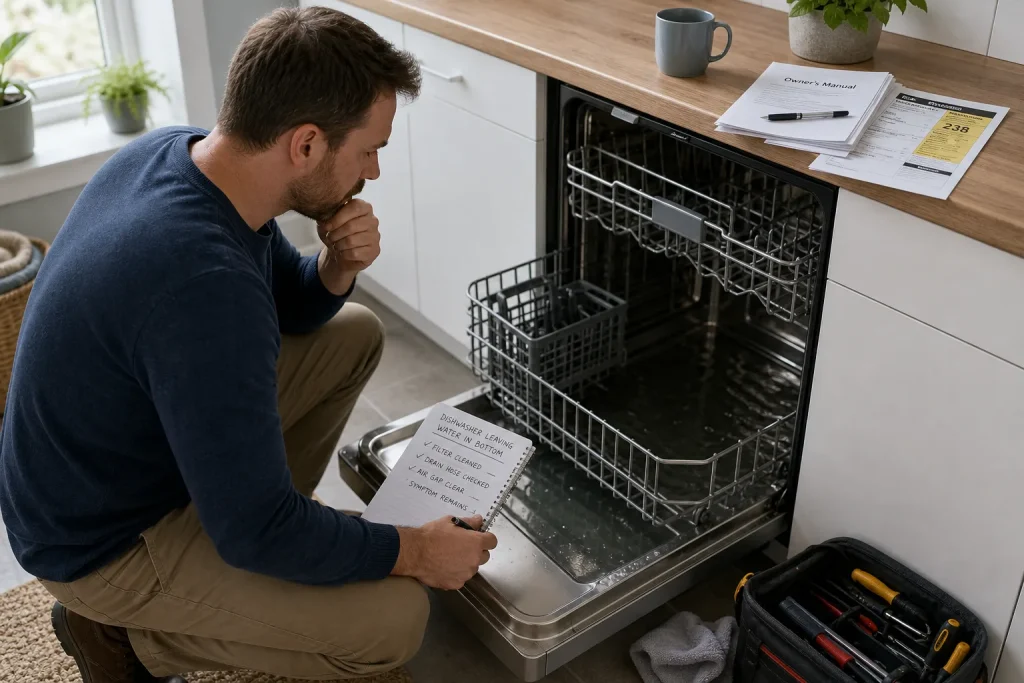
Imagine your dishwasher has begun leaving water in the bottom, while the rest of its cycles are normal. You clear the filter as the manual directs, but the symptom remains. A technician identifies a drain-related fault and gives you an estimate, while the model information shows that a comparable replacement would need a different installation arrangement. You would compare the repair’s scope and parts availability with the full replacement cost and installation work—not simply choose a new dishwasher because it is newer. If the repair is clear and the machine otherwise serves you, keeping it may make sense. If the diagnosis is uncertain and other faults are appearing, replacement may be the more dependable choice.
That example has no universal answer, which is the point. Choose the option that best fits the appliance’s condition, your actual use, the clarity of the repair plan, and the consequences of being wrong. If the decisions are close, the least disruptive option may be preferable, provided it is safe and performs the job adequately.
What is not worth the effort?
Do not spend an afternoon comparing every feature on every appliance in a category you do not need. Nor is it useful to compare a large-capacity model with a compact one solely by their energy labels; size and expected use affect the comparison. Avoid repeated resets or improvised repairs when the manual does not recommend them. They can obscure the symptom or create a hazard.
It is also not worth treating a familiar brand, a sleek display, or a bold efficiency claim as a substitute for model-specific information. Check the label, dimensions, installation needs, and service options. If a seller cannot explain a relevant feature in plain terms, leave it off your decision list until you can verify what it does.
What should you do before deciding?
Finish with a short record: the model number, the symptom, the checks permitted by the manual, the repair estimate, and the replacement information you compared. Keep receipts, service notes, and warranty details where you can find them. If you choose repair, ask what maintenance the manual recommends and what signs should prompt another call. If you replace the appliance, confirm installation and removal arrangements before delivery.
Then make the decision and stop shopping for a hypothetical perfect option. A working appliance that suits your household is often a better fit than a new one with features you will ignore. The useful question is not whether replacement is possible, but whether it solves a real problem better than keeping or repairing what you already have.